AI Readiness: A Practical Framework for Manufacturing and Industrial Leaders
|
Basic Summary AI readiness is an organization’s capacity to effectively adopt and leverage artificial intelligence across data, infrastructure, governance, and workforce capabilities. For manufacturers and industrial service companies, readiness determines whether AI projects create measurable business value or stall in pilot mode. This article outlines a practical framework to assess your current state and move toward successful AI implementation. Who This Is For
Key Takeaways
|
What AI Readiness Really Means
AI readiness is an organization’s, system’s, or workforce’s capacity to effectively adopt and leverage artificial intelligence. It covers data quality, technology infrastructure, governance, and strategic planning. At its core, readiness answers a simple question: can your business move from AI exploration to operational implementation in a way that improves performance and delivers business value?
In the current AI era, it is easy to confuse experimentation with progress. Many companies test AI tools but fewer organizations build the foundation required for successful AI implementation at scale. AI readiness requires a realistic assessment of your current state across infrastructure and governance. It also requires clarity about how AI technology fits into your broader business strategy.
For independent manufacturers and industrial service companies, AI readiness means building capabilities that support operations and create measurable gains in efficiency and decision-making.
Why AI Readiness Matters Now
Across the world, companies are adapting to rapid advances in AI models and large language model platforms. Governments and industry groups are introducing frameworks and AI readiness scores to measure progress. The EU, China, and the United States are all shaping rules and expectations for governing AI systems.
These developments affect industrial businesses directly. Suppliers and customers alike are all exploring how to use AI responsibly. Falling behind in readiness does not just limit innovation; it also undermines it. It increases risk. Poorly governed AI systems can expose data and undermine trust.
At the same time, organizations that assess and strengthen their AI readiness position themselves to explore AI opportunities with confidence. They can deploy AI services in operations, quoting, inventory management, document tracking, and reporting dashboards without creating new vulnerabilities.
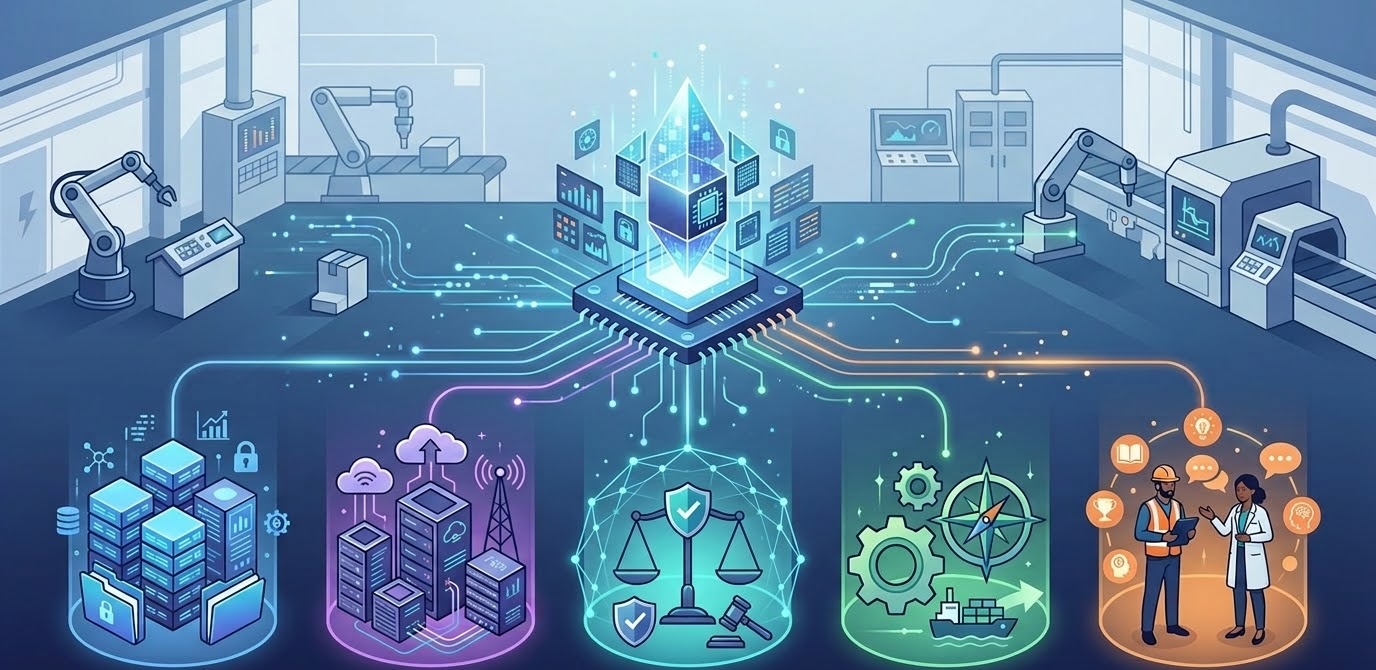
The Five Key Pillars of AI Readiness
A comprehensive framework for AI readiness typically includes five key dimensions. These pillars help assess where your business stands and where to focus investment.
Data Readiness
Data is the foundation of artificial intelligence. Without secure and well-organized data, even the most advanced AI models will underperform.
For manufacturers, data sources often span ERP software, inventory systems, production logs, maintenance records, and customer portals. These systems may have developed over years, sometimes decades. In many cases, data lives in silos or legacy platforms that were never designed with AI in mind.
Data readiness involves evaluating if your data is accurate and accessible. It also requires clear rules for security and privacy. Before investing in AI deployment, organizations must assess whether their data is actionable and trustworthy.
Key questions at this stage include: Do we know where our critical data lives? Is it consistent across systems? Can we extract and transform it without disrupting operations? If the answer is unclear, AI projects will struggle.
Infrastructure and Technology
AI infrastructure must support increased processing demands and secure integration. For many mid-market companies, the current infrastructure was built for transactional workflows rather than AI workloads.
Being AI-ready means having scalable, robust IT systems that support AI tools and models. This may include modern cloud environments, updated APIs, secure integration layers, and staging environments for testing.
Infrastructure readiness is about ensuring your existing ecosystem can adapt. In industrial settings, downtime is costly. Any AI initiative must protect operational continuity while introducing new capabilities.
At NorthBuilt, we often see businesses eager to deploy AI while their underlying systems need modernization. Addressing infrastructure gaps early prevents unnecessary risk and supports long-term progress.
Governance and Ethics
AI governance is no longer optional. Governing AI involves establishing clear frameworks for security and responsible use. This includes defining who can access AI systems and how outcomes are monitored.
In regulated industries or businesses serving global markets, governance must align with evolving rules and standards. AI readiness needs continuous monitoring of AI systems in production.
Without governance, AI adoption can create unintended consequences. With governance, organizations can deploy AI services with confidence and transparency.
For industrial companies, governance also supports trust with customers and partners. A structured approach to AI governance signals maturity and professionalism.
Strategy and Leadership
AI strategies must align with business objectives. Leadership sponsorship is critical. When AI initiatives are disconnected from operational goals, they often stall.
Strategy begins with clarity about desired outcomes. Are you aiming to reduce manual data entry? Improve forecasting accuracy? Enhance quoting speed? Support predictive maintenance?
AI readiness requires leaders who can translate high-level innovation goals into focused initiatives. It also requires a mindset that views AI as a long-term capability, not a one-time project.
Distinct groups within the business may have varying levels of AI knowledge. Leadership must create alignment across operations. This alignment ensures that AI projects receive the resources and support they need to succeed.
Skills and Culture
Even the best AI infrastructure will not deliver results without the necessary skills. AI literacy across the workforce is a defining component of readiness.
This does not mean every employee must understand AI models in detail. It does mean your teams should be able to evaluate AI outputs and integrate AI into workflows responsibly.
Developing internal expertise supports sustainable adoption. It also reduces dependence on external vendors for every adjustment. Organizations that invest in talent and foster a culture of innovation are better equipped to adapt as AI technology evolves.
Moving From Exploration to Implementation
Many companies are currently in the exploration phase. They test generative AI for content creation or experiment with automation in isolated processes. Exploration is valuable, but readiness is measured by the ability to implement AI at scale.
Successful AI implementation requires coordination across data, infrastructure, governance, strategy, and skills. Weakness in any one area can delay or derail deployment.
Case studies across industries show a consistent pattern. Organizations that begin with a clear readiness assessment are more likely to achieve measurable business value. Those who skip this step often encounter integration challenges or governance gaps that force them to pause.
A practical readiness index for your organization does not need to be complex. It should provide visibility into your current capabilities and identify specific areas for improvement. This allows you to adapt your AI strategies based on reality rather than assumptions.
Practical Steps to Assess Your AI Readiness
For manufacturing and industrial leaders, the assessment process should be grounded in operations. Start by mapping your core systems and identifying where AI could realistically improve performance.
Evaluate your data quality and accessibility. Review your infrastructure for scalability and security. Document existing governance policies. Assess internal skills and knowledge. Finally, confirm leadership alignment around clear objectives.
This assessment can reveal strengths and gaps. In some cases, your business may already be AI-ready in certain areas, while other components require development.
If you are unsure how to structure this evaluation, reviewing a structured process can help. NorthBuilt’s approach to discovery and onboarding focuses on understanding systems, identifying risks, and building a roadmap that supports long-term success. You can learn more about that in our process.
Building AI Capabilities That Last
AI readiness is not a one-time milestone. It is an ongoing commitment to strengthening your data, technology, and talent. As AI models evolve, your organization’s ability to adapt will determine sustained performance.
For independent businesses, the goal is not to compete with global tech giants. It is to use AI effectively within your specific ecosystem. That means integrating AI into existing ERP software, reporting dashboards, quoting tools, and inventory management systems in a way that supports operations rather than disrupting them.
Continuous monitoring is essential once AI systems are deployed. Performance and compliance must be reviewed regularly. This ensures AI services remain aligned with business goals and industry standards.
Ultimately, AI readiness positions your organization to capture AI opportunities while managing risk responsibly. It transforms AI from a buzzword into a practical capability that strengthens operations.
Preparing for the Future Without Falling Behind
The pace of innovation will not slow down. Companies that ignore AI entirely risk falling behind. Companies that rush forward without readiness create avoidable challenges.
The balanced path forward begins with honest assessment and practical planning. By focusing on the key pillars of AI readiness, industrial and manufacturing leaders can build a foundation that supports innovation and protects core operations.
If you are evaluating your organization’s AI readiness and want a grounded, practical perspective on how your existing systems can support AI deployment, you can schedule with our team.
NorthBuilt works alongside independent businesses to modernize infrastructure and support long-term software performance. In the AI era, the companies that succeed will be those that build carefully and invest in capabilities that last.

Chris Morbitzer
Chris Morbitzer is CEO and co-founder of NorthBuilt, a Minnesota-based software development partner that helps independent manufacturers, agricultural companies, and industrial services firms across the Midwest implement AI and build practical technology solutions.