What AI Tools for Change Management Do
|
Quick Summary Who This Is For
Key Takeaways
|
AI tools for change management are software and AI-powered assistants that help change managers plan initiatives, draft communications, track employee responses, and personalize training as an organization moves to new systems or processes. They don’t replace the change manager. They take repetitive analytical and drafting work off their plate so that they can focus on the parts AI can’t do.
Change management almost always means something concrete for Midwest manufacturers and industrial businesses. It could look like a new ERP system, a dealer portal replacing a spreadsheet, or an automation tool replacing a manual process. The technology itself is only half of that rollout. The other half is convincing the people who run production, quoting, and inventory that the new system is worth learning. That’s where AI tools for change management can help.
What AI Capabilities Do in Change Management
Most AI tools built for change management fall into a few core capabilities.
- Communication drafting is the most common use case. AI can turn a bullet-point outline into a first draft of a stakeholder email, FAQ page, or training script. It still needs a human to edit it, because a generic draft rarely accounts for the specific worry your shop floor supervisor has about a new scheduling tool.
- Employee sentiment analysis pulls signals out of survey responses and open-text feedback to flag where resistance is building before it becomes a problem. Change managers rarely have time to read every comment by hand. Data-driven insights like these let you catch a struggling team in week two instead of week eight.
- Personalized training paths adjust what an employee sees based on their role or how they’re using a new system. A warehouse worker and an accounting clerk don’t need the same onboarding sequence for a new inventory platform.
- Digital adoption platforms sit inside a piece of software and guide users through it in real time the first few times they use a new feature. These show up more often in large enterprise rollouts than in the custom, purpose-built systems many manufacturers run, where that guidance needs to be built in from the start through automation consulting.
None of these capabilities plan a change initiative for you. McKinsey’s research on gen AI adoption states that the organizations getting real value are the ones treating AI as a capability layered onto clear business goals, not a replacement for the planning itself.
Where AI Fits in the Change Management Process
The change management process usually includes assessing the impact, planning the rollout, communicating and training, then measuring adoption. AI is used a little differently in each one.
During planning, AI can estimate which teams and workflows a change will touch, based on how existing systems connect, surfacing dependencies a change manager might miss where one change ripples into quoting, inventory, and scheduling at once.
During communication, AI speeds up drafting and helps segment messages by role so a plant manager and a line worker get relevant, not identical, information.
Training and support are where automation is most useful. Routine questions like “how do I submit a request” and “where did this report go” get handled by a well-built assistant instead of tying up a supervisor’s time. Agentic AI, tools that take a limited action rather than just answer a question, goes further by being able to flag a stalled task, nudge someone who hasn’t logged in for a week, or escalate a repeated complaint to a human before it grows into resistance.
During measurement, sentiment and usage data give change managers something more concrete than a gut feeling, echoing what we cover in how AI shows up across a broader business digital transformation.
The Human Side of Change Management AI Can’t Replace
Employees resist change for reasons that show up in sentiment data but don’t get solved by it. They don’t trust the new system will make their job easier. They’ve seen a rollout fail before and assume this one will too. Some are worried the automation will replace them.
Sentiment data will show you resistance building on the production floor. Rebuilding trust with a skeptical supervisor after a previous vendor burned it takes a conversation, and that conversation belongs to a person. IBM’s own research on AI in change management concludes that AI strengthens the discipline of change management outside of judgment calls.
Manufacturing and industrial settings can be trickier than in the office-software rollouts most AI change tools were built for. Employees aren’t just learning a new interface. Many are changing a physical process they’ve done the same way for years, sometimes with equipment or safety procedures wrapped around it. Personalizing the training material helps. It can’t replace a supervisor walking the line and answering the same question five different ways until it lands.
Custom GPTs and Agentic AI for Change Practitioners
Many of the AI tools marketed to change managers are trained on public change management theory that gives the same advice to a hospital reorganizing its scheduling system as it does to a manufacturer installing a new dealer portal.
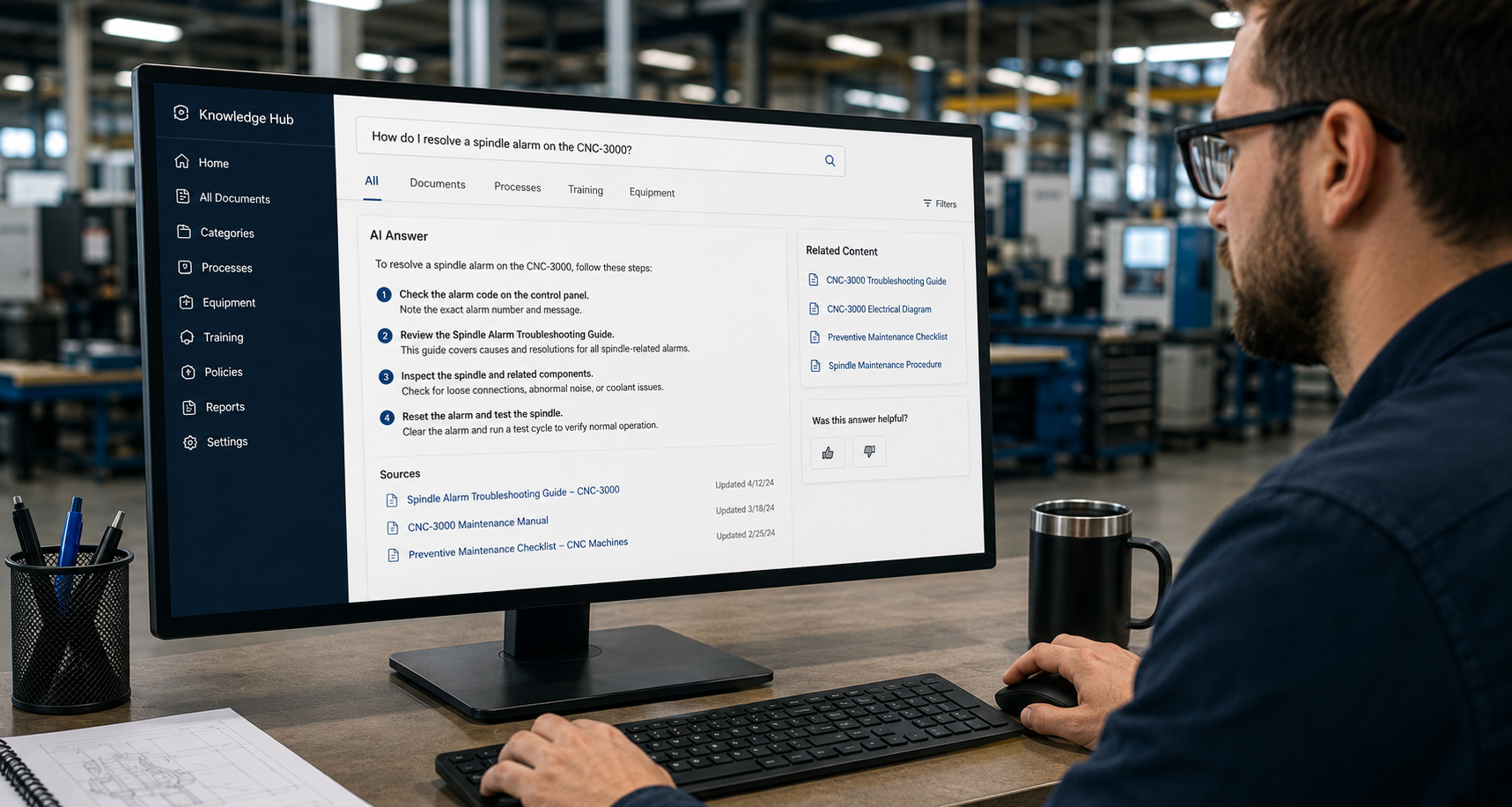
A custom GPT is built on your own change playbooks, policy documents, and history of past rollouts, giving change practitioners answers grounded in what happened last time. Ask it how a previous ERP rollout handled resistance from second-shift workers, and it pulls from your own documentation.
Building one requires a clear scope, clean source documents, and a defined process for keeping it updated as your playbooks change. A custom GPT trained once and never touched again goes stale the same way any other system does. Agentic AI, the kind taking action rather than just answering questions, needs even more structure. It needs clear permissions for what it can do on its own, logging so a human can see what it did, and an escalation path for anything it shouldn’t handle alone.
This is closer to a custom software project than an off-the-shelf purchase, like what we discuss in our guide on developing AI software that fits real workflows.
Why Most AI-Driven Change Initiatives Stall
We’ve watched this pattern play out with custom software for years, and AI-driven change tools are following the same script, just faster. A vendor or consultant stands up an impressive AI-powered tool for the rollout, gets a good result in the first few weeks, and moves on to the next project. Six months later, the sentiment dashboard hasn’t been checked in a while, the custom GPT is answering questions based on a policy that changed in March, and nobody on staff understands the system well enough to fix it.
It’s the same build-and-leave pattern that’s failed manufacturers on custom software for years. A single person who understood the tool moves on, and the business is stuck with something nobody can maintain.
Someone needs to own the AI tools supporting your change initiatives the same way someone owns your quoting system. A team that knows your systems beats a single person who happened to build them, because a team doesn’t disappear when one person takes another job. If your business doesn’t have that role covered internally, fractional CIO services can fill it without a full-time hire.
Getting Started with AI in Your Change Management Process
You don’t need every capability described here for your next rollout. Pick the one or two that address your biggest issues, such as sentiment tracking if you’re unsure how employees feel or a custom GPT if your change managers keep answering the same questions, and build from there.
What matters more is who’s responsible for them after launch. Software nobody maintains degrades quietly, and an AI tool that goes stale is worse than no tool at all, because people stop trusting the answers it gives them.
If you’re planning a system change and want AI tools that support your change management process, book a call with NorthBuilt. We build custom software and AI tools for Midwest manufacturers, and we’re here to help post-launch.
Frequently Asked Questions
What are AI tools for change management?
Software applications that help change managers plan initiatives, draft communications, track employee sentiment, and personalize training during a transition to new systems or processes.
How do change managers use AI capabilities day to day?
Most change practitioners use AI to draft stakeholder communications, review feedback data for early signs of resistance, and route employees to role-relevant training content. More advanced use cases involve custom GPTs trained on a company’s own playbooks and agentic AI that flags a stalled task without a person prompting it.
Can AI replace a change manager?
No. AI can process data and draft content faster than a person, but it can’t rebuild trust with a skeptical employee or read the room in a difficult meeting. That work still requires a person.
What’s the difference between a custom GPT and off-the-shelf change management software?
Off-the-shelf tools are trained on general change management theory and give the same advice to any company that uses them. A custom GPT is built on your own policies and past rollouts, giving change practitioners answers from what’s happened inside your organization.